The Home journal
Seller Guide · The Money · Salt Lake City
The Money
How Do I Buy and Sell at the Same Time?
2026-09-23 · Delia Bayna, REALTOR® · eXp Realty, LLC | Luxury · 5 min read
The Short Answer
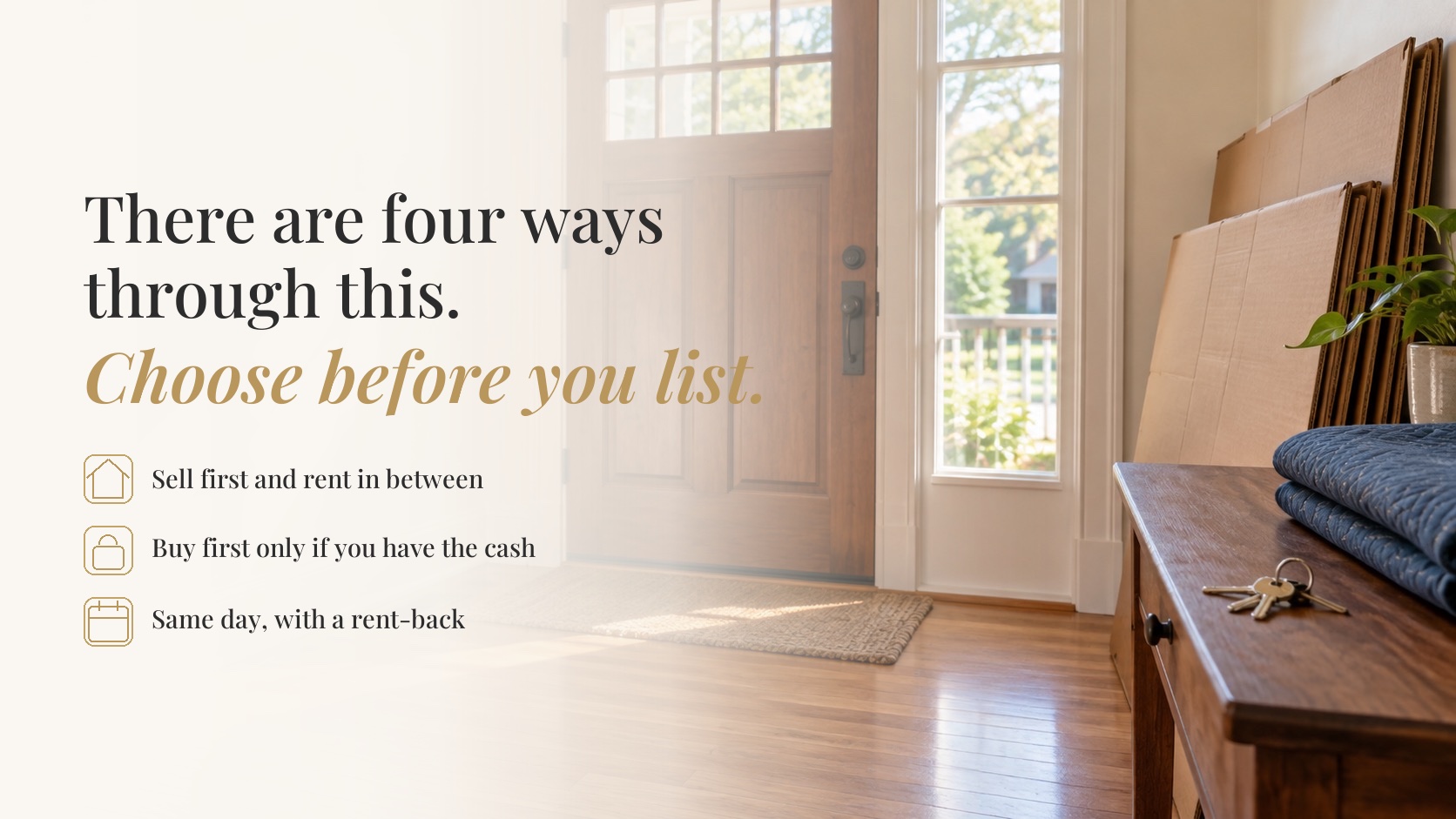
There are four ways through this, and only four. Sell first and rent in between. Buy first using money you already have access to. Sell with a contingency that you find your next home. Or sell and buy on the same day with a rent-back so you do not move twice. Which one fits you depends almost entirely on whether your money is stuck in the house you are trying to leave.
This is the question that stops more downsizers than price ever does. Not "should I move," but "how do I move without ending up somewhere I do not want to be, with nowhere to go."
So here are the four, including what each one costs you.
Option One: Sell First, Rent in Between
What it is: you sell, you move into a rental for a few months, then you buy without any pressure at all.
What it gets you: the strongest possible position as a buyer. Your money is in the bank, your offer has no strings attached, and you can take your time. In a competitive situation this is worth real money.
What it costs you: two moves. That is not a small thing, especially out of a house you have been in for decades. It is physically hard, it is expensive, and it is emotionally harder than people expect.
Who it fits: someone whose money is entirely in the house, and who would rather deal with one hard season than carry a risk they cannot afford.
Option Two: Buy First
What it is: you buy the next place before selling this one, using funds you already have access to.
What it gets you: one move. You go directly from here to there, at your own pace, and you never live in a box.
What it costs you: you have to be able to carry both, at least briefly, and you need a source of funds that does not depend on this house selling. That is the whole catch. For the sellers I work with most, the money is in the house, which makes this one unavailable no matter how appealing it sounds.
Who it fits: someone with real liquidity outside the home, and the stomach for a period of owning two.
Option Three: Sell With a Contingency
What it is: you sell, but the contract says the sale depends on you successfully finding and closing on your next home.
What it gets you: a real safety net. You are not forced out with nowhere to go.
What it costs you: it makes your listing less attractive to some buyers, because they are taking on your uncertainty. In a slower market that may cost you nothing. In a competitive one it can cost you buyers or price.
Who it fits: someone who genuinely cannot risk being without a home and would rather trade some negotiating power for that certainty. It is a legitimate trade and I will never talk you out of it.
Option Four: Same Day, With a Rent-Back
What it is: you close both transactions close together, and if the timing does not line up perfectly, you arrange to stay in your sold home for a short period after closing, paying the new owner.
What it gets you: one move, and the money from the sale is available for the purchase.
What it costs you: coordination, and the risk that if one side slips, everything behind it slips too. This is the option that depends most on the people involved doing their jobs.
Who it fits: someone whose money is in the house but who cannot face moving twice. It is the most common path for my downsizing clients, and it is the one that needs the most planning.
The Thing That Actually Decides It
Notice that three of the four come down to the same question. Is your money stuck in this house?
If the answer is yes, and for most of my clients it is, your real choice is between option one and option four. Between moving twice with total safety, or moving once with careful coordination.
That is a real decision with a real tradeoff, and there is no wrong answer. What there is, is a wrong way to arrive at it, which is by accident, at the last minute, under pressure.
What I Would Do
Pick your path before you list, not during.
Every one of these requires different things from your contract, different timelines, and different conversations with your lender. A seller who chose option four in advance has a plan. A seller who backs into it in week three is managing a problem.
And whichever you choose, build in a backup. I treat every move as a planned project with a Plan A and a Plan B, because in this specific situation the cost of being wrong is not money. It is a person in their seventies with nowhere to sleep. I take that seriously, and I will not let it happen to you.
Here is what I would do, here is what it costs, and it is your call. I will support it either way.
Frequently Asked Questions
What is a rent-back?
An agreement that lets you stay in your home for a short period after you have sold it, paying the new owner for that time. It is used to bridge a gap between your closing and your move into the next home, and the terms are negotiated as part of the sale.
Will a contingency hurt my sale?
It can, because some buyers will not take on your uncertainty. How much it costs you depends on the market at that moment. In exchange you get certainty that you will not be without a home, which for some sellers is worth more than the difference.
Should I sell first or buy first?
It depends on whether you have access to money outside the home you are selling. If your equity is your only source of funds, buying first is usually not available, and the real choice is between selling first and renting, or coordinating both with a rent-back.
This article is general information and is not legal, tax, or financial advice. Loan options and qualification are questions for a lender.